Corrour Partnership – a living laboratory for interdisciplinary research and sustainability

A 100-year partnership between the University of St Andrews and Corrour is advancing landscape-scale ecological restoration through cutting-edge research, teaching, and policy impact.
The Partnership
The Corrour X University of St Andrews Partnership brings together the University of St Andrews and Corrour in a long-term collaboration for nature-based climate mitigation, and research and teaching.
Together, we are creating a living laboratory at Corrour that advances the shared missions of both institutions:
- Corrour’s mission is to be a leading example of landscape-scale ecological restoration, encouraging natural processes to return and flourish.
- The University’s sustainability strategy commits to achieving net zero by 2035 and leading global transitions through research, education, and partnership.
Corrour is a key contributor to the St Andrews Forest — a flagship initiative of the University’s Environmental Sustainability Strategy. Through a nature-based carbon agreement, Corrour supports the University’s journey to net zero by providing high-integrity, additional carbon units from woodland regeneration and peatland restoration.
Our joint ambition is to generate research that:
- Informs land management at Corrour and beyond
- Supports nature recovery through science and innovation
- Enhances public policy and national climate strategies
- Broadens sustainability learning and community collaboration
Corrour is a 57,000 acre upland land holding in the Scottish Highlands. It is made up of a number of enterprises, including hydroelectric power generation from its rivers, tourism and nature restoration. Corrour has beenpioneering a data-led approach to restoring its landscape for over 15 years including;
- open range deer management to allow for restoration fo natural processes on the open hill, enabling native trees and plants to establish, restoring biodiversity and building resilience to climate change
- Restructuring of historic commercial plantation woodland to native habitats including native woodland and bog habitats
- Restoration of missing or fragile habitats and populations such as montane shrub species.
- Freshwater habitat restoration, exploring ways to improve the quality of the rivers and lochs to support biodiversity and climate resilience.
- Peatland Restoration: Rewetting damaged peatlands raises water tables, prevents further carbon loss, and rebuilds habitat for a wide range of species.
Corrour has a history of partnering with academic institutions and other interest groups to undertake monitoring and research used to inform its land management decisions. This living, working landscape offers an opportunity to undertake a wide range of applied research projects from ecology, climate and beyond.
Research and collaboration opportunities
We invite researchers from across all disciplines to propose projects that explore, question, and contribute to our understanding of ecological restoration and sustainability in its broadest sense, including the natural sciences, social sciences, arts and humanities, technology, policy, economics, and interdisciplinary approaches.
Benefits of working at Corrour include:
- Access to 57,000 acres of restored upland landscape with a wide range of habitats in different states of recovery: woodland (both natural and manmade), peatland, freshwater, grassland.
- Long-term ecological datasets and monitoring sites
- Free use of a new purpose-built Corrour Research Centre (opening Summer 2026) at Corrour, sleeping 24, with conference, lab and residential facilities, embedded in Corrour’s dramatic landscape.
- Access to a team of land managers from a range of disciplines with experience and expertise in rural land management.
- Letters of support for funding applications.
- Opportunities for student fieldwork and teaching.
- 6 week paid internship available to St Andrews students, based at Corrour opening for summer 2026.
All visits to the Corrour Research Centre must be associated with a proposal. See the process for submitting and proposal here.
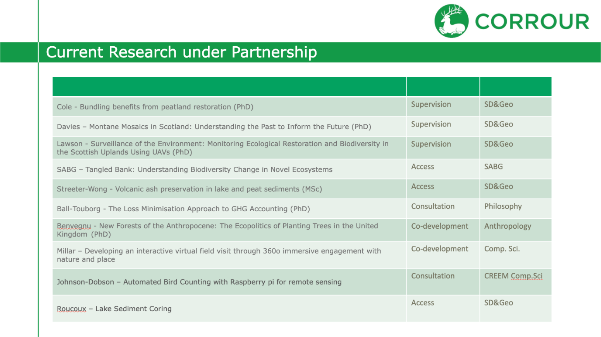
Current Projects
Key Dates
- Next Board Meeting: 21st November 2025
- Proposal Submission Deadline: 24th October 2025
Projects may be submitted at any time and will be reviewed quarterly in line with Board meetings.
Current and Completed Projects
Corrour is already hosting a growing portfolio of interdisciplinary research. Learn more about the projects on Corrour:
Corrour woodland at Loch Treig